Posts

Showing posts with the label Tamil Nadu

Thai Pongal: Harmony Between Nature and Humanity

Image
Thai Pongal is one of the most vibrant and deeply cherished festivals celebrated in Tamil Nadu and the Union Territory of Puducherry. Observed every January, it coincides with the harvest season and marks the Sun’s transition from the southern to the northern hemisphere. This celestial event symbolizes the end of winter and the arrival of spring. At its core, Thai Pongal is a thanksgiving festival dedicated to the Sun God, embodying themes of gratitude, renewal, and community harmony. Etymology of Thai Pongal The word Thai refers to the tenth month in the Tamil calendar, while Pongal carries meanings such as festivity, celebration, and “overflow” or “boiling over.” Pongal is also the name of the sweet dish prepared during the festival, made of rice, lentils, milk, and jaggery. The act of boiling over symbolizes abundance and prosperity, reflecting the Sun’s northward journey toward the equinox. Historical Roots Thai Pongal history spans more than a millennium. Epigraphic evide...

Monuments of Madurai: Temples, Palaces, and Heritage

Image
Madurai, often referred to as the temple city , is one of the oldest and most culturally significant cities in Tamil Nadu. Situated along the banks of the Vaigai River, it has been a center of pilgrimage, learning, and art for over two millennia. The city was home to the famous Sangams , gatherings of poets and scholars that produced remarkable Tamil literature. Over time, Madurai came under the rule of the Sangam rulers, Vijayanagara kings, and later the Nayakas, each leaving behind monuments that continue to define the city’s heritage. Religious Monuments in Madurai Meenakshi Sundareshwar Temple The Greatest Attraction of Madurai is The Meenakshi Amman Temple , dedicated to Lord Shiva (Sundareshwara) and Goddess Parvati (Meenakshi). Originally built by Pandya King Kulasekara, it was later expanded by successive rulers. The temple complex is laid out in a lotus-like formation, with concentric streets radiating outward. Architecture: Twelve towering gopurams rise from g...

The Heart of Tamil Nadu’s Heritage: Pudukkottai District

Image
Introduction Situated in the southern state of Tamil Nadu, Pudukkottai district is a region where history, culture, and spirituality blend seamlessly. Officially recognized as a district in January 1974 after being carved out of Tiruchirappalli and Thanjavur, Pudukkottai spans 4,663 square kilometres. Its 39-kilometre-long coastline along the Bay of Bengal not only enhances its geographical significance but also contributes to its economic activities, particularly fishing and maritime trade. Geographically, the district lies between 78°25′ and 79°15′ Eastern longitudes and 9°50′ and 10°40′ Northern latitudes. It shares borders with Tiruchirappalli to the north and west, Sivaganga to the south, Thanjavur to the northeast, and the Bay of Bengal to the east. This strategic location has made Pudukkottai a centre of commerce, cultural exchange, and spiritual heritage in Tamil Nadu. Historical Background The history of Pudukkottai is deeply rooted in the legacy of the Thondaiman rulers...

Vellore District: A Tapestry of Heritage, Culture, and Progress

Image
  Introduction Vellore district, nestled in the northern part of Tamil Nadu, is a region steeped in history and cultural richness. Often referred to as the "City of Spears" a name derived from the Tamil words Vel (spear) and Oore (city) Vellore has played a pivotal role in shaping South Indian history. It has been the seat of several powerful dynasties including the Pallavas, Cholas, Nayaks, Marathas, Arcot Nawabs, and the Bijapur Sultans. The district’s strategic importance was evident during the Carnatic Wars of the 17th century, and it was also the site of the infamous Vellore Mutiny of 1806, a precursor to India's First War of Independence. Spanning an area of 5,920.18 square kilometers, Vellore District lies between 12°15′ to 13°15′ North latitudes and 78°20′ to 79°50′ East longitudes. As per the 2001 census, the district had a population of over 3.4 million. Vellore city, the district headquarters, is well-connected by road and rail to major cities in Tamil N...

Dharmapuri District: A Tapestry of Heritage, Nature, and Progress

Image
  Introduction Dharmapuri District, nestled in the northwestern part of Tamil Nadu, is a region rich in history, culture, and natural beauty. With Dharmapuri town serving as its administrative headquarters, the district had a population of approximately 2,856,300 as per the 2001 census. Originally part of Salem District post-independence, Dharmapuri gained its distinct identity on October 2, 1965. Later, in 2004, Krishnagiri District was carved out of Dharmapuri, further refining its administrative boundaries. The district is linguistically diverse, with Tamil as the predominant language, alongside Kannada, Telugu, and Urdu spoken by various communities. History of Dharmapuri District The Historical Roots of Dharmapuri trace back to the Sangam era, when it was known as Thagadur a name derived from the Tamil words "Thagadu" (iron ore) and "ur" (place), indicating its mineral wealth. The earliest known ruler of this region was Adigaman Naduman Anji, a chieftain...

Periya Eri Lake: Echoes of a Lost Waterbody and a Call for Reviva

Image
Introduction Periya Eri Lake, literally meaning “Big Lake,” is a once-prominent waterbody on the fringes of Chennai in the southern Indian state of Tamil Nadu. Also referred to as Pallavaram Lake, it was a vital ecological asset and a visual landmark so expansive that passing trains on the railway line from Pallavaram to Chromepet were visible even from its banks. However, over decades of urbanization, mismanagement, and pollution, the lake has been reduced to a mere shadow of its original form. This article explores its past glory, present condition, and the challenges threatening its survival, with insights into the broader implications for Chennai's water crisis. Historical Significance and Natural Spread Periya Eri Lake once sprawled across an impressive 189 acres, acting not only as a source of water but also as a buffer against floods during monsoons. The ecosystem around it thrived with aquatic life, migratory birds, and local vegetation all supported by its clean water...

Lakes in Tamil Nadu: Nature’s Reservoirs and Tourist Treasures

Image
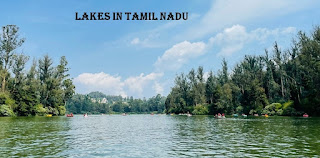
Tamil Nadu, the southernmost state of India, is a land of rich cultural heritage, architectural marvels, and natural beauty. While its temples, hill stations, and beaches often steal the spotlight, The Lakes of Tamil Nadu are equally captivating. These water bodies not only support the ecological balance and provide essential resources like drinking water and irrigation, but also serve as serene retreats for tourists and locals alike. From ancient man-made reservoirs to scenic high-altitude lakes, Tamil Nadu Lakes are as diverse as they are vital. Ambattur Lake: Chennai’s Lifeline Located in the bustling city of Chennai, Ambattur Lake is a crucial rain-fed reservoir. It plays a significant role in supplying drinking water to the city’s residents. Along with Korattur Aeri and Madhavaram Aeri, it forms a chain of interconnected water bodies that help manage excess rainfall by transferring water from one lake to another. This system is not only practical but also a testament to the i...